
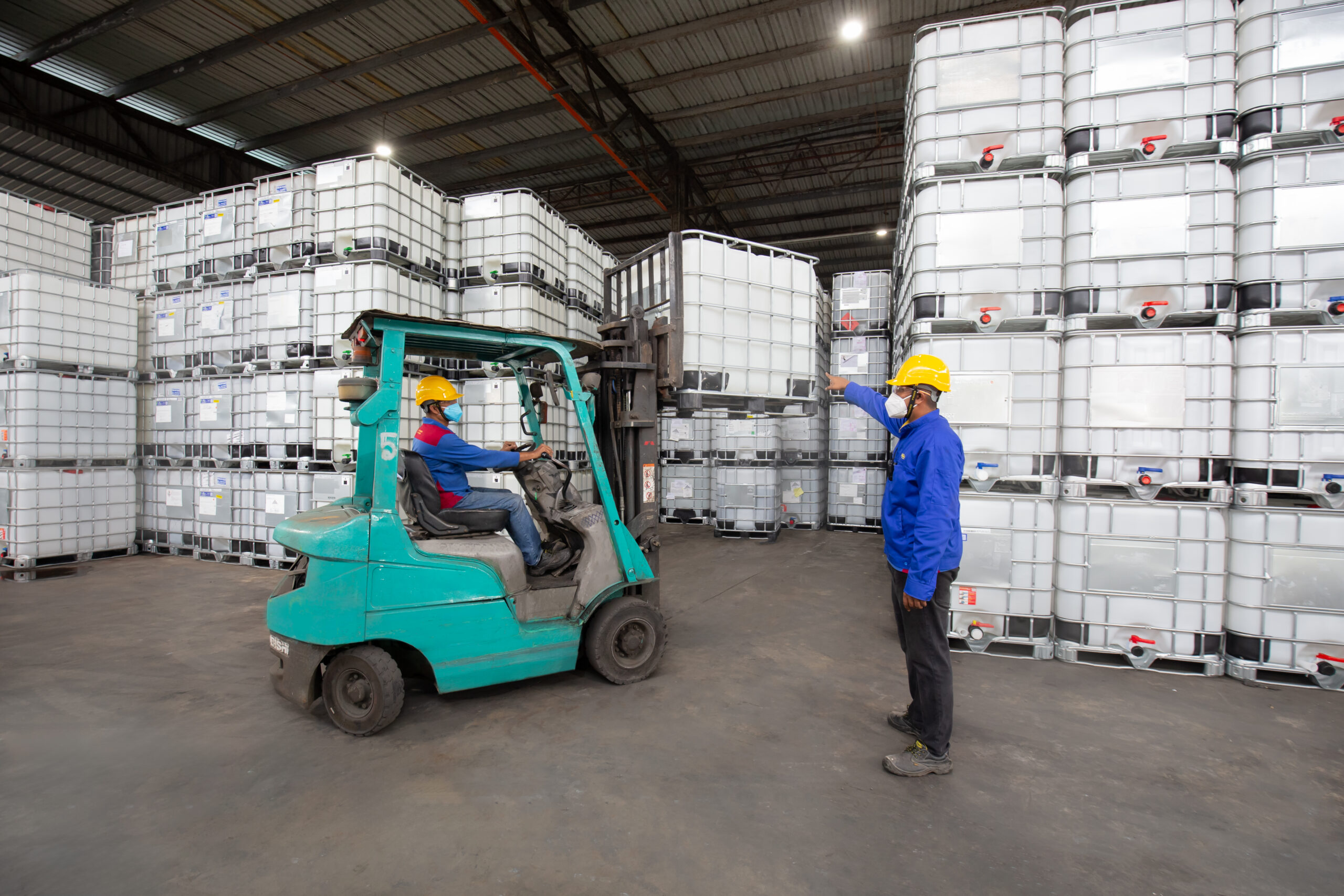
1. Start with the container type
The first decision is the broad container family.
Ranama’s current public reconditioned-container range includes:
- Drums
- IBC Tote Tanks
- Jerrycans / Carboys
- Jumbo Bags
The drum range is further divided into:
- Plastic / HDPE drums
- Steel drums
- Poly-composite drums
Starting with the container family prevents unrelated products from being compared as though they serve the same requirement.
For example, the information that matters when comparing a 1000L IBC is not identical to the information used to compare a 30L Jerrycan or a 210L steel drum.
2. Use capacity to narrow the range
Capacity is one of the simplest ways to narrow a container requirement.
Ranama’s current public product information includes different recorded capacities across different product families.
For example:
- Plastic / HDPE drums — 30L, 60L, 120L, 160L and 220L configurations
- Steel drums — 210L
- Poly-composite drum — 210L
- IBC Tote Tank — 1000L
- Jerrycans / Carboys — 20L, 25L and 30L
Capacity alone, however, does not establish that two containers are interchangeable.
A 220L HDPE drum and a 210L steel drum differ in more than nominal volume.
Material, configuration, closure, dimensions and other technical characteristics also need to be considered.
3. Identify the material where it matters
Material can be another important selection factor.
Within Ranama’s current drum range, the public product architecture distinguishes between:
- Plastic / HDPE
- Steel
- Poly-composite
Jerrycans / Carboys in the current published range are recorded as High Density Polyethylene — HDPE.
Material information describes the construction of the container.
It does not, by itself, establish compatibility with every intended content, process or operating environment.
Material tells you what the container is made from.
It does not automatically tell you everything the container is suitable for.
4. Understand the difference between Open Top and Tight Head drums
For drum requirements, configuration is especially useful.
Two terms appear repeatedly in Ranama’s current drum range:
Open Top
An Open Top drum uses a removable top arrangement.
Within the current Ranama range, Open Top configurations appear across both HDPE and steel drum products.
Tight Head
A Tight Head drum has a closed-head configuration with defined closure openings rather than a removable full top.
Ranama’s current range includes Tight Head configurations in HDPE, steel and poly-composite drums.
Knowing whether your requirement calls for an Open Top or Tight Head configuration can immediately narrow the relevant product pathway.
5. Check the dimensions—not only the capacity
Two containers can have similar capacities while differing in their external dimensions.
Dimensions may matter when a requirement involves:
- Existing storage space
- Racking or warehouse arrangements
- Material-handling equipment
- Existing operational layouts
- Container-positioning requirements
Ranama’s individual product pages publish dimensions where that information is available.
The format of those dimensions may differ by product.
For example, one product may provide overall diameter and height, while another may provide length, width and height.
Use the values published for the specific container rather than assuming that one container’s dimensions apply to another.
6. Look at the closure information
Closure information helps distinguish products that may otherwise look similar.
Depending on the container, the published information may describe items such as:
- Bung closures
- Caps
- Lids
- Gaskets
- Closing rings
- Latch rings
The exact closure differs by product.
For example, Ranama’s current Jerrycan / Carboy range uses a published 60 mm Tamper-Evident DIN61 cap specification, while individual drum products use different closure arrangements.
The relevant product page should remain the source for the exact closure specification.
7. For steel drums, check the interior treatment
Steel drums should not be compared only by capacity and top configuration.
Ranama’s current 210L steel drum range includes different interior treatments.
These include current product records for:
- Plain interior
- Internally epoxy-lined Tight Head configuration
- Internally lacquer-lined Open Top configuration
These terms should be kept distinct.
An Open Top product recorded as lacquer lined should not be described as epoxy lined simply because another steel drum uses an epoxy interior.
The exact product specification matters.
8. Weight and other characteristics may differ by product
Some product records publish weight or tare weight.
Others may not.
The same applies to details such as:
- Colour
- Handles
- Internal opening
- Pallet configuration
- Valve type
- Interior treatment
- Closure type
- Other construction characteristics
Not every container has the same specification fields.
That is normal.
The important rule is:
If a technical detail is not published for the product, it should not be assumed.
9. Do not turn a material statement into a suitability claim
Technical descriptions need to be read carefully.
For example, some current HDPE source records state that the container was:
Manufactured from food grade material
That describes the recorded source material.
It should not automatically be converted into statements such as:
- Food-safe container
- Suitable for food
- Food-contact approved
- Approved for a particular food process
A material description and an application-suitability decision are not the same thing.
If your requirement depends on compatibility, food contact, regulatory approval or another application-specific condition, include that requirement when enquiring.
10. Product specifications describe the container—not every possible application
This is one of the most important distinctions in industrial-container selection.
A published specification may tell you:
- What the container is
- Its capacity
- Its dimensions
- Its material
- Its closure
- Its configuration
- Its weight
- Its colour
- Its interior treatment
Those facts do not automatically establish suitability for every intended content, operating environment or process.
For that reason, avoid selecting a product solely because one specification appears to match.
The complete requirement still matters.
11. Some product requirements need a requirement-led conversation
Not every product family should be forced into a fixed specification table.
Ranama’s Reconditioned Jumbo Bag capability is one example.
At launch, fixed dimensions, material, construction, load rating and other detailed technical values are not published as universal Jumbo Bag specifications.
If your requirement depends on those details, provide the information you already have when enquiring.
That is more reliable than assuming a generic Jumbo Bag specification from another supplier or from general internet information.
12. Availability is another question—not a specification
Technical information can help identify the right container, but it should not be confused with live availability.
Ranama does not publish live stock levels at launch.
Product availability is confirmed against the specific:
- Container
- Quantity
- Requirement
when you enquire.
That means a product page should be used to understand the container first, while availability is confirmed through the enquiry process.
A practical specification checklist
Before requesting a quote, work through the information you already know.
[CHECKLIST]
Container family
Do you need a drum, IBC, Jerrycan / Carboy or Jumbo Bag?
Material
Where relevant, do you already know whether the requirement involves plastic / HDPE, steel or poly-composite?
Capacity
What nominal capacity do you require?
Configuration
For drums, is Open Top or Tight Head relevant?
Dimensions
Are there dimensional restrictions or known size requirements?
Closure
Does the closure arrangement matter to the requirement?
Interior treatment
For relevant steel drums, is a particular recorded interior configuration part of the requirement?
Quantity
How many containers do you need?
Location
Where is the requirement located?
Application-specific requirements
Is there any content, process, compatibility, regulatory or operating requirement that needs to be considered?
You do not need every answer before enquiring
A specification checklist is useful, but it should not become a barrier to starting the conversation.
If you know only the container family, approximate capacity, quantity and location, begin there.
If you already know the dimensions, closure or other technical requirements, include those too.
The purpose is to provide enough context to move from a broad container search towards the most relevant current product information.
Explore Ranama’s Current Reconditioned Container Range
Ranama’s current public range includes reconditioned drums, a 1000L IBC Tote Tank, Jerrycans / Carboys and Reconditioned Jumbo Bags.
The drum range covers plastic / HDPE, steel and poly-composite configurations.
Review the relevant product page for the technical information available for the container you are considering.